Tearing into a 100-year-old plaster ceiling just to pull a low-voltage communication wire is the fastest way to get a commercial HVAC retrofit shut down by building inspectors. When you are upgrading climate controls in historic properties or fully occupied hotels, traditional hardwired daisy-chains are a logistical and financial nightmare. Deploying a wireless commercial FCU thermostat network via smart gateways completely bypasses the prohibitive labor costs and structural damage of traditional hardwired BMS retrofits.
For HVAC contractors and facility managers, the demand for non-destructive commercial HVAC control is soaring. Today, leveraging secure sub-GHz or Zigbee wireless commercial FCU thermostats paired with smart gateways has emerged as the premier upgrade strategy for legacy fan coil unit systems.
The Hidden Costs of Wiring Legacy Buildings
Most of the budget in a commercial HVAC control upgrade doesn't actually go to the hardware. It gets eaten alive by labor and building tear-downs. Trying to force a hardwired BACnet MS/TP or IP network into a legacy space means facing brutal on-site realities:
- Ripping Open Finished Drywall: You are looking at drilling through solid concrete firewalls and cutting into pristine plaster just to pass RS485 cables to every FCU. In historic properties, this structural modification often violates local preservation codes.
- Killing Revenue with Downtime: You cannot rent out a hotel floor or keep a corporate office productive with contractors pulling copper wires in the ceiling above people's heads. Time spent fishing wires is direct revenue lost.
- The Asbestos Nightmare: Open up a ceiling in any commercial building constructed before the 1980s, and you risk triggering a massive, highly regulated asbestos abatement protocol that will bankrupt the project budget.
The Wireless Alternative for FCU Retrofits
This is exactly why commercial integrators have abandoned copper pulls for wireless retrofits. You skip the destructive wire-fishing entirely. Instead, the wall units handle the communication payload over robust Zigbee or RF networks.
RF Receivers: Bypassing the Wall Drop
The cleanest way to handle a retrofit is to wire a compact RF receiver straight into the actual FCU terminal block hiding up in the ceiling. Once that relay is hooked up to local mains power, you simply mount the wireless thermostat on the wall wherever it makes sense. The wall unit runs on batteries (or taps into old existing low-voltage lines), and the switching link between the wall and the machine is completely invisible.
Mesh Networking: Defeating Concrete Interference
Contractors used to avoid wireless setups because early point-to-point versions dropped signals constantly. That is history. Modern protocols like Zigbee 3.0 utilize self-healing mesh networks. Every single powered receiver acts as a signal booster. The more devices you install across the hotel, the stronger the network gets, effortlessly pushing data through heavy concrete floors and elevator shafts.
Building a "Lightweight BMS" via Wireless Gateways
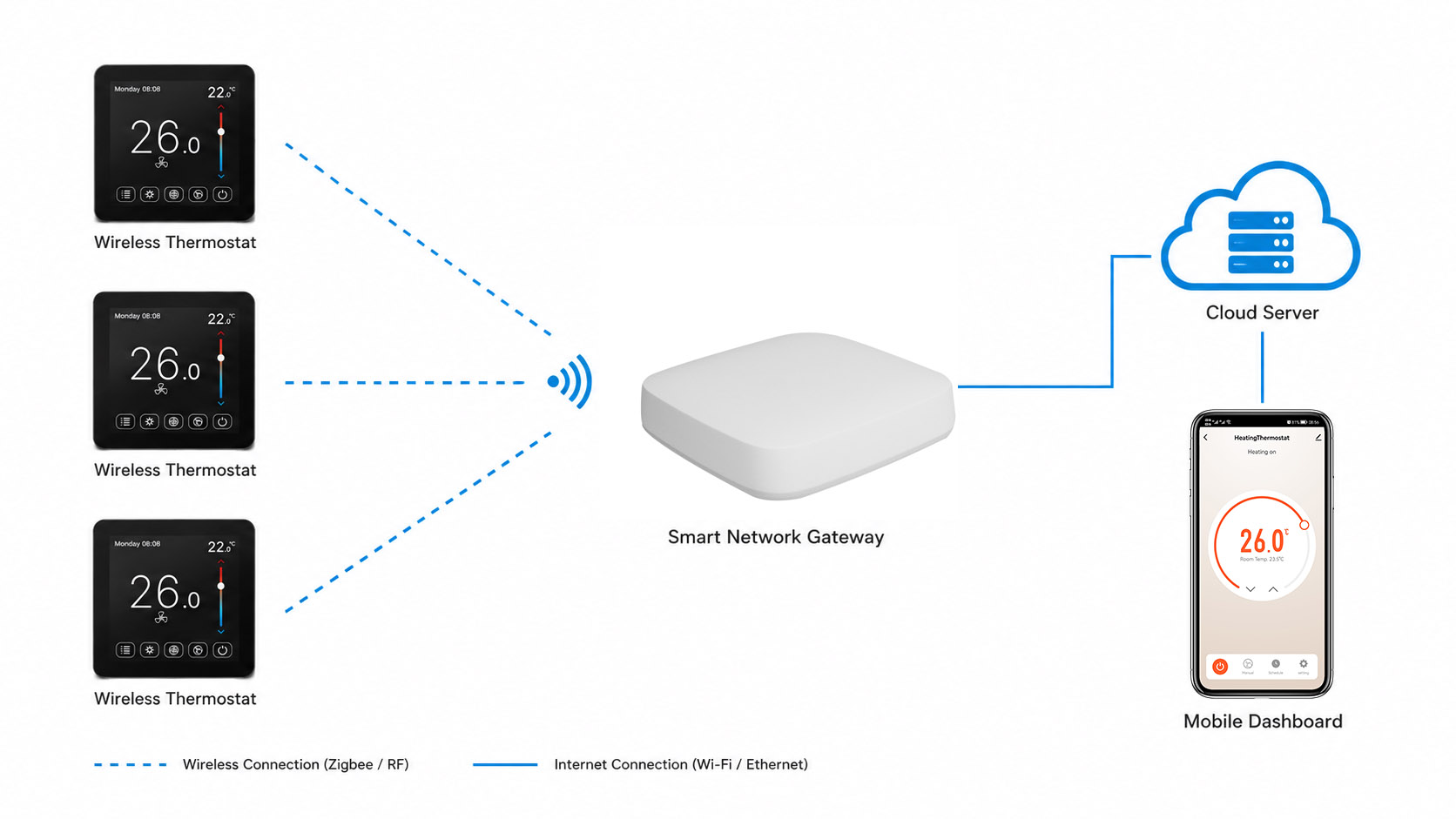
A collection of standalone wireless thermostats is great for individual rooms, but facility managers ultimately demand centralized control. That is where the Smart HVAC Gateway changes the architecture.
You plug a single IoT gateway into the building's IT router. That hub talks wirelessly to fifty or a hundred thermostats scattered across different floors, aggregating their telemetry and pushing it to a secure cloud server. What you get is a "lightweight BMS." The building manager can sit at a laptop, monitor room temperatures in real-time, execute hard lockouts so guests cannot freeze the compressor, and push global energy setbacks. It delivers the operational functionality of a massive wired BMS, but for pennies on the dollar.
As a specialized OEM/ODM manufacturer, E-TOP Controls designs highly reliable wireless thermostats, heavy-duty RF receivers, and smart gateways specifically engineered for the rigors of commercial retrofits. Elevate your HVAC brand or scale your next multi-dwelling unit (MDU) project with our proven wireless manufacturing capabilities. Contact our engineering team today to review your project scope and secure robust B2B hardware solutions.
Frequently Asked Questions (FAQs)
+ Q1: Are wireless commercial thermostats reliable enough for multi-story office buildings?
A: Yes. Modern commercial systems use Zigbee mesh networking or sub-GHz LoRaWAN. Unlike traditional point-to-point Wi-Fi that relies on a single router, each powered node acts as a signal repeater. As you add more thermostats to different floors, the network actually becomes stronger and more resilient, bypassing structural interference.
+ Q2: Why not just use standard consumer Wi-Fi thermostats for a hotel retrofit?
A: Consumer Wi-Fi thermostats are a nightmare at a commercial scale. Putting 200 thermostats on a hotel's Wi-Fi network chokes the bandwidth for guests, creates massive IT security vulnerabilities, and leads to constant dropouts as commercial firewalls block unrecognized device traffic.
+ Q3: Do I need to replace my existing HVAC equipment to use a wireless BMS upgrade?
A: No. The core advantage of retrofit controls is backward compatibility. By installing a wireless RF receiver module directly at the existing fan coil unit's electrical panel, it instantly translates wireless commands from the new wall thermostat into the physical relay clicks your legacy machinery understands.
+ Q4: How many thermostats can a single smart HVAC gateway support?
A: Depending on the specific protocol (like Zigbee 3.0), a single commercial-grade gateway can typically support between 50 to 100 wireless thermostats. For larger facilities, multiple gateways are deployed across the IP network and aggregated seamlessly into a unified cloud dashboard.
+ Q5: Are wireless commercial thermostats secure against tenant tampering?
A: Absolutely. Because they are tied to a smart gateway, facility managers can push hard lockouts to the wall units remotely. Tenants or hotel guests can only adjust the temperature within a strict, predefined range (e.g., 68°F to 74°F), protecting compressors from freezing over and capping energy waste.