Ordering hundreds of PTAC thermostats for a major hotel retrofit carries a hidden risk: if the new controllers don't match the in-room heat pump wiring or lack a 24V power supply, the installation crew will hit a brick wall on day one. It happens far too often across North American commercial HVAC jobs, costing contractors both time and money.
Procurement teams can stop these rollout disasters before they start. The trick is verifying three non-negotiable specs: 2H/2C staging support, a dedicated 24V C-wire connection, and native integration with whatever hotel management app the property uses.
Before diving into the technical weeds, if you are new to hospitality procurement and wondering what does PTAC mean? It’s an acronym for Packaged Terminal Air Conditioner. You’ve seen them—they are those bulky, self-contained heating and cooling boxes sitting right under the windows in almost every hotel or apartment building.
Planning out your HVAC thermostat applications means looking past a sleek touchscreen to see what's actually under the hood. Here are the precise technical parameters your engineering team should validate before approving any bulk purchases.
| Feature to Check | Consumer Retail (Skip these) | Commercial Standard (Must-have) |
|---|---|---|
| System Staging | 1H/1C (Single stage only) | 2H/2C with Aux Heat support |
| Power Source | AA Batteries (High maintenance) | C-Wire or dedicated base module (24V) |
| Sensor Logic | On-board internal sensor only | Supports plug-in external sensors |
| Guest Controls | Fully unlocked limits | Admin setpoint lockouts & Tuya App |
1. Multi-Stage System Compatibility (2H/2C)
Every PTAC unit runs on slightly different logic. Some systems only handle basic cooling, but many modern North American setups use heat pumps combined with backup electric heating strips for freezing winter nights. If you install a basic single-stage controller here, your guests will be freezing during a cold snap.
You need to specify a controller capable of two stages of heating and cooling (2H/2C). More importantly, it must integrate smoothly with heat pumps containing auxiliary (Aux) heat. Securing this level of compatibility allows a hotel to stock just one universal thermostat model across the entire property.
2. The C-Wire Power Requirement (24V)
Wi-Fi chips and backlit screens draw constant electrical current. Relying on standard AA batteries in a commercial environment is a logistical nightmare. Your maintenance team will lose hours every month just swapping out dead batteries in guest rooms.
Always check the technical sheet for a C-wire (common wire) connection. A common wire draws a continuous 24V from the HVAC gear itself, so your PTAC smart control never goes dark. If a direct wire isn't an option, a decoupled system paired with a hardwired base module does the exact same job of preventing power drops.
3. Smart Voice Integration and External Sensors
Travelers increasingly expect smart home features. A solid commercial controller should link directly to iOS and Android applications, while also processing voice commands natively through Google Assistant or Amazon Alexa.
Don't stop at mobile app support—check for external temperature sensor inputs. Thermostats slapped on a wall near a drafty hallway or baked in afternoon sunlight always read the room wrong. Routing a discreet external sensor to the center of the room guarantees the climate stays exactly where the guest wants it.
Meet the E-TOP CH7400 Solution
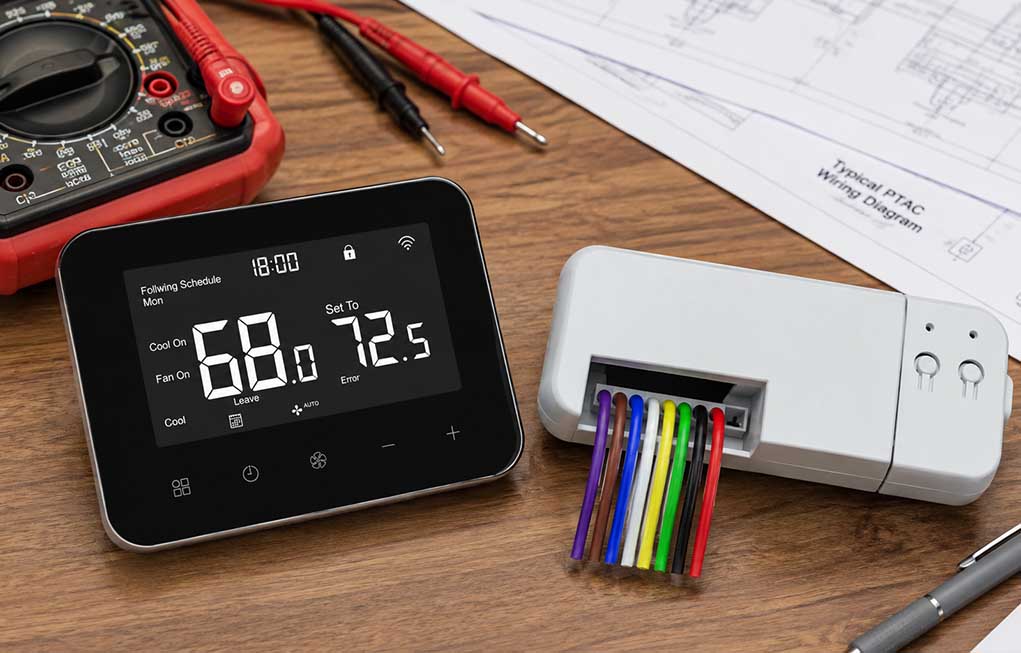
We engineered the Wireless WIFI Smart Thermostat and Module for PTAC (CH7400) to check off every single requirement on this list. It handles complex 2H/2C heat pump configurations effortlessly, utilizes continuous 24V power for rock-solid stability, and includes external sensor inputs right out of the box.
Looking to Source PTAC Controls at Scale?
We handle extensive OEM/ODM customizations. That includes providing white-label designs built exclusively for the demands of the hospitality sector.
Check the Full Specs of CH7400 ➔Frequently Asked Questions (FAQs)
+ Q1: What does 2H/2C actually mean on a PTAC spec sheet?
A: Simply put, the thermostat manages two heating stages and two cooling stages. It fires up the primary heat first. If the room is still chilly, it calls in the secondary backup heater (like an electric strip). For commercial heat pumps, this staging is absolutely critical.
+ Q2: Why is a C-wire connection such a big deal for commercial PTAC controls?
A: Bright screens and active Wi-Fi radios chew through batteries incredibly fast. A C-wire feeds a steady 24 volts directly from the HVAC unit to the thermostat. It guarantees your network won't drop and saves your maintenance crew from changing thousands of AA batteries every few months.
+ Q3: Will the CH7400 work with a heat pump that uses auxiliary heat?
A: Yes, we built it to handle those exact complex setups. It runs heat pumps flawlessly, shifting between the main compressor and the electric auxiliary strips based on whatever the room temperature dictates.
+ Q4: Is wiring an external temperature sensor really worth the extra effort?
A: Definitely. If a thermostat sits too close to a drafty door or right above the PTAC itself, it gets confused and misreads the room. Dropping a small, remote sensor into the actual living area forces the system to match the guest's true comfort level, rather than just the air temperature next to the wall.
+ Q5: Can guests control these thermostats with the Tuya app or voice commands?
A: They sure can. The whole system ties right into the Tuya Smart App ecosystem. It also natively handles voice prompts from Amazon Alexa and Google Assistant, giving hotel guests that modern, hands-free experience they expect.