For mechanical engineers and building automation specifiers, achieving perfect indoor climate control while adhering to strict energy regulations is a constant balancing act. In high-end commercial HVAC control systems, traditional on/off relay controls simply cannot meet the precise thermal demands of modern infrastructure. The industry standard has definitively shifted toward proportional control, making the 0-10V thermostat a mandatory component for maximizing Fan Coil Unit (FCU) efficiency.

The Paradigm Shift: Traditional On/Off vs. 0-10V Proportional Control
To understand the value of a modulating fan coil thermostat, we must first look at the structural limitations of legacy systems.
The Flaws of On/Off (Bang-Bang) Control
Traditional 3-speed thermostats operate on a simple binary logic. When room temperature deviates from the setpoint, the thermostat opens the valve 100% and blasts the fan at a fixed speed. Once the target is reached, it shuts off completely. This creates noticeable temperature fluctuations (the "yo-yo" effect), excessive mechanical wear, and high acoustic noise each time the relay engages.
The Precision of Proportional (0-10V) Control
A 0-10V modulating thermostat utilizes advanced PID algorithms. Instead of a rigid on/off command, it outputs a continuous analog voltage signal ranging from 0 to 10 volts. If the room needs minor cooling, the thermostat might output a 3V signal, slightly opening the valve and running the fan at a whisper-quiet low speed. This results in a flat, perfectly stable temperature curve.
How 0-10V Drives EC Motors and Modulating Valves
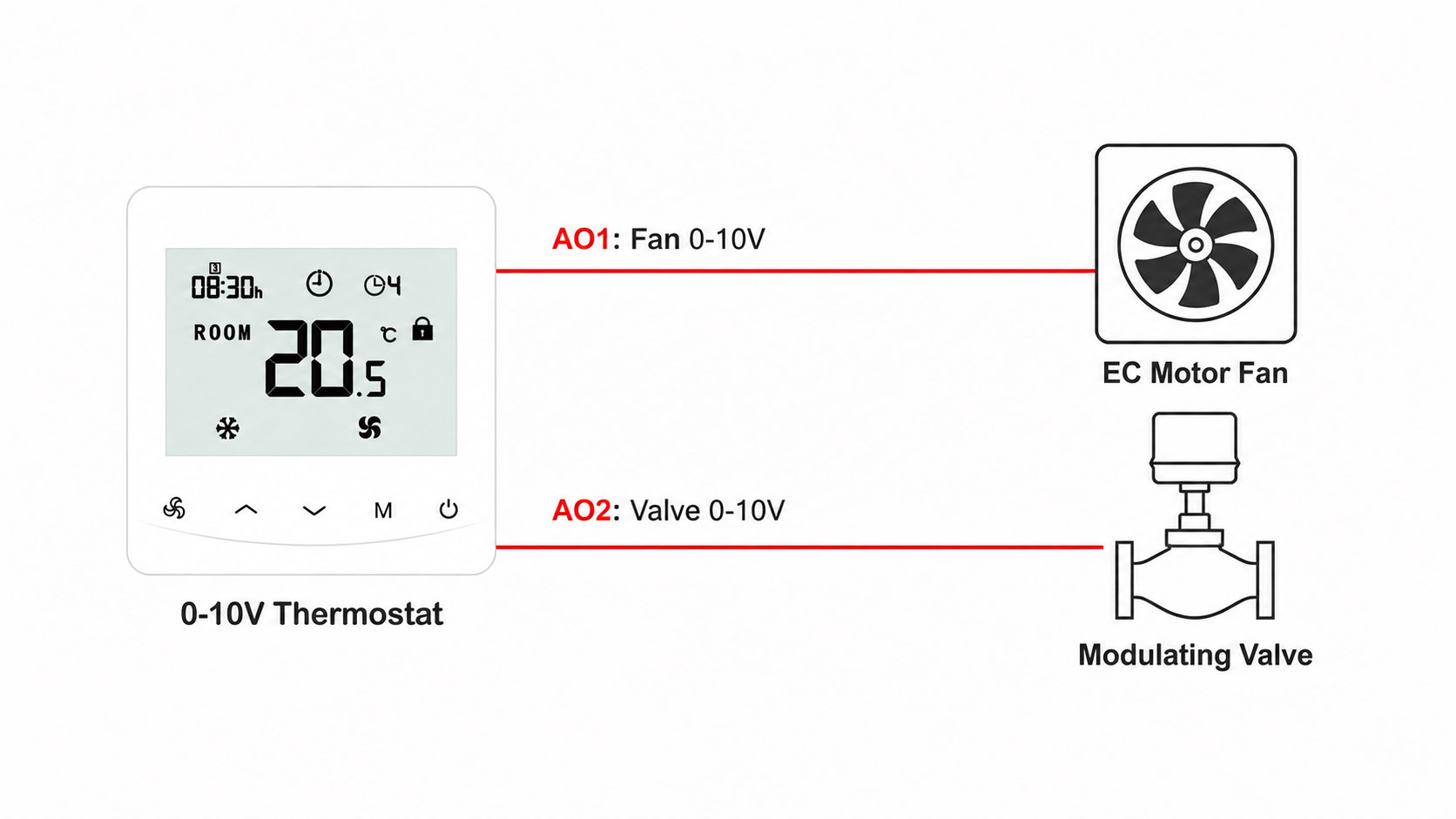
The true power of this protocol lies in its ability to directly communicate with the mechanical endpoints of the FCU via dedicated analog outputs.
EC Motor Thermostat Integration (AO1)
Electronically Commutated (EC) motors are the gold standard for modern HVAC fans. Unlike AC motors stuck with three fixed speeds, an EC motor thermostat uses the 0-10V signal (typically wired to AO1) to provide stepless, variable fan speed control (0% to 100%). This drastically reduces energy consumption—operating a fan at 50% speed consumes only about 12.5% of the power required at full blast, adhering strictly to fan affinity laws.
Modulating Water Valves (AO2)
Similarly, a secondary 0-10V signal (AO2) controls proportional actuators on chilled or hot water valves. By regulating the exact flow of water through the coil based on real-time thermal demand, the system eliminates "water hammer" issues in the piping and prevents the over-cooling or over-heating associated with standard thermal wax actuators.
Why High-End Commercial Buildings Mandate 0-10V
In premium architectural projects, 0-10V control is no longer optional; it is written into engineering specifications for several critical reasons:
- Hospitals and Clean Rooms: These environments require strict temperature and humidity tolerances. Modulating fan coil thermostats maintain exact setpoints without sudden airflow bursts that could disrupt cleanroom pressurization.
- Class A Office Buildings: To achieve LEED or BREEAM ratings, developers must utilize energy-efficient EC motors. Furthermore, stepless fan control provides superior acoustic comfort, eliminating the distracting click and hum of relays engaging during meetings.
- BMS Integration: Modern 0-10V controllers feature built-in RS485 communication ports, allowing facility managers to monitor voltage outputs and override local settings from a central dashboard.
Source OEM 0-10V Thermostats for Your Project
As a leading ISO-certified manufacturer, E-TOP Controls designs high-precision modulating thermostats compatible with major EC motor and valve brands. Connect with our R&D team for custom OEM/ODM solutions and seamless BMS integration.
Inquire NowFrequently Asked Questions (FAQs)
+ Q1: How do I upgrade a traditional 3-speed FCU system to 0-10V modulating control?
A: Upgrading to a 0-10V system requires ensuring your Fan Coil Unit is equipped with an Electronically Commutated (EC) motor and a proportional valve actuator. Standard AC motors and thermal on/off valves cannot interpret 0-10V analog signals directly. Once mechanical endpoints are compatible, E-TOP offers versatile 0-10V thermostats that seamlessly drive these components.
+ Q2: What is the advantage of a 0-10V thermostat over standard On/Off controls?
A: Unlike standard On/Off controls that cause temperature swings and mechanical wear, a 0-10V modulating thermostat provides a continuous analog signal for stepless adjustment of fan speeds and water valves. This precision ensures whisper-quiet operation, exact temperature stability, and compliance with stringent commercial energy standards.
+ Q3: Can 0-10V modulating thermostats be integrated into a commercial BMS?
A: Yes. E-TOP's modulating FCU thermostats can be customized with built-in communication ports, supporting standard Modbus RTU or BACnet MS/TP protocols. This allows facility managers to seamlessly connect room-level 0-10V controls into centralized Building Management Systems.
+ Q4: How are AO1 and AO2 terminals utilized in a 0-10V thermostat?
A: Typically, AO1 (Analog Output 1) is dedicated to sending the 0-10V signal to control the EC fan motor speed smoothly. AO2 (Analog Output 2) is used to transmit the proportional voltage signal to the modulating water valve actuator, ensuring precise thermal regulation.
+ Q5: Do 0-10V EC motor thermostats help achieve LEED or green building certification?
A: Absolutely. Because EC motors at part-load consume exponentially less electricity than constant-speed AC motors, implementing 0-10V modulating controls significantly reduces a building's overall energy consumption profile, directly contributing points toward green building standards like LEED and BREEAM.